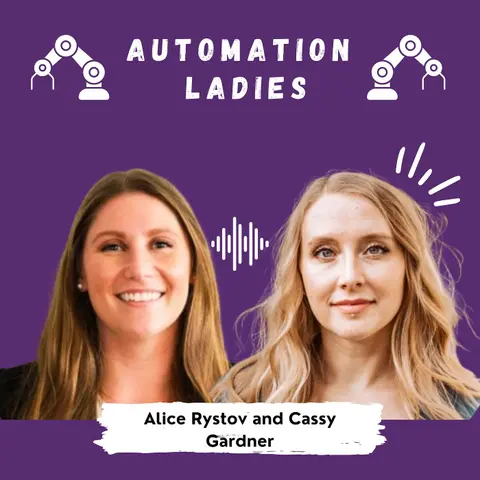
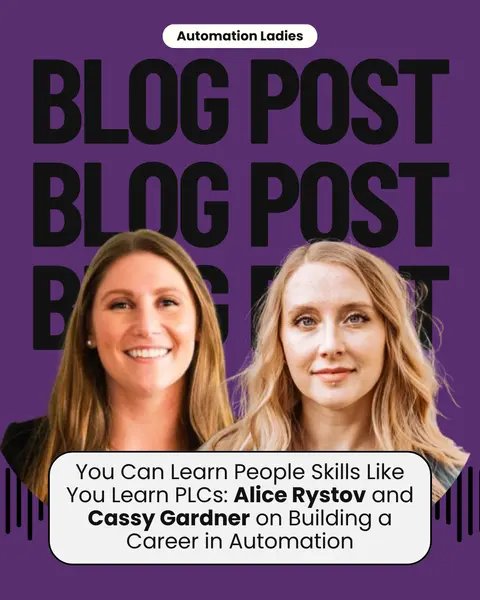
You Can Learn People Skills Like You Learn PLCs: Alice Rystov and Cassy Gardner on Building a Career in Automation
What does it actually take to build a successful career in industrial automation?
According to Alice Rystov and Cassy Gardner from e Tech Group, the answer goes far beyond knowing how to program a PLC.
In this episode of Automation Ladies, Alice and Cassy share their journeys into automation, talk about why there is no single degree that guarantees a career in controls, and explain why skills like communication, curiosity, active listening, and problem-solving can be just as important as technical knowledge.
They also get into some of the realities of working in automation: commissioning, troubleshooting, project planning, scope creep, management, mistakes, and learning how to navigate the transition from school to industry.
There Is No Single Path Into Automation
Both Alice and Cassie came into automation through engineering degrees, but neither followed a traditional "controls engineer" path.
Alice graduated from UC Davis in 2015 with a degree in chemical engineering. She found her way into automation through friends who were already working in the field and quickly discovered that she enjoyed programming. She started on the client side before moving to an integration company, where she eventually moved into leadership.
Cassy also graduated from UC Davis, but with a degree in bioengineering. Her interest in automation started with an instrumentation and controls class during her senior year. A connection between her professor and an industry professional led to an internship at Banks Integration, where she discovered that she enjoyed the people, challenges, and environment of the industry.
Their experiences are a good reminder that automation does not have one obvious feeder degree.
Alice has hired people with backgrounds in mechanical engineering, electrical engineering, and even biology. Cassy points out that companies in the industry are already accustomed to training engineers on the specific skills they need.
What can matter just as much is curiosity, problem-solving ability, comfort with computers, and the ability to communicate with other people.
For anyone considering a career in automation, that opens up a lot of possibilities.
Mentorship Can Help You Get Your Foot in the Door
When asked what advice they would give engineers looking to get into controls, both Alice and Cassy immediately focused on building connections.
Alice recommends finding a mentor. She and Cassy both enjoy helping students and young professionals understand the industry and explore career opportunities.
She also points to practical ways students can start building relevant skills. One example they discuss is Ignition's free core credential for students, which can give someone interested in controls a way to start developing experience with a technology that is widely used in industry.
Cassy's number-one recommendation is informational interviews.
The idea is simple: find someone who works in the field you're interested in, reach out, and ask if they would be willing to spend 30 minutes or an hour talking about their career.
That conversation can help you understand what the industry is actually like, learn about potential career paths, build a professional connection, and potentially discover opportunities you would not have found otherwise.
And as Cassy points out, you do have to be willing to talk to strangers.
But sometimes those strangers are people who are happy to help.
You Don't Have to Become a Manager to Move Forward
Management is often treated as the natural next step for engineers who want to advance their careers.
Alice thinks that is changing.
She explains that more companies are creating opportunities for engineers to remain technical while advancing into roles such as principal engineer or technical subject matter expert. Not everyone who wants to grow professionally actually wants to manage people, and that should be okay.
At the same time, if management is something you are interested in, Alice and Cassy believe those skills can be learned.
Alice points out that people who are not naturally "people-focused" can sometimes become excellent managers because they recognize their gaps and build systems around them. Check-ins, calendars, data, and deliberate communication can all help someone become a better manager.
Cassy describes the role of a manager as taking care of the people reporting to them while also helping the team accomplish the work the company needs.
That means finding opportunities for employees, helping them reach their goals, coaching them, providing feedback, and understanding what motivates different people.
And one of the best ways to get experience before becoming a manager?
Mentoring someone else.
Active Listening Is a Leadership Skill
One of the strongest themes throughout the conversation is the importance of active listening.
Alice explains that managers can easily make assumptions about what their employees want based on their own experiences. But not everyone has the same goals, working style, or preferred level of interaction.
Some employees might want weekly one-on-ones. Others may prefer meeting every few weeks. Some want to become managers. Others want to stay technical.
The manager's job is not to make everyone follow the same path.
It is to listen.
Cassy takes that idea further. She describes several important parts of being a good listener:
-
Validate what the other person is saying.
-
Ask clarifying questions.
-
Pay attention to the feelings behind what someone is telling you.
-
Understand what motivates the person in front of you.
That can mean asking an engineer whether they enjoy programming, working with data, solving technical problems, or talking with people.
Good leadership starts with understanding the person you're actually working with.
Bridging the Gap Between School and Industry
The transition from university to industry can be a shock.
Alice remembers learning things like fluid mechanics and the Reynolds number in school, only to enter the workforce and be asked to troubleshoot a VFD.
The connection between the two isn't always obvious.
That gap between academia and industry is something both Alice and Cassy believe companies need to help bridge.
Alice regularly visits colleges and talks to students about what automation actually looks like. She believes experience and mentorship can help students understand the industry before they enter it.
Cassy also emphasizes that companies should expect to train new graduates.
A new engineer is not expected to walk into a project knowing how to connect to a PLC and make changes independently. Companies should provide training and resources.
But there is also responsibility on the engineer.
New engineers should be willing to try, use the resources available to them, communicate when they are stuck, and take ownership of their work.
That leads to one of the funniest lessons in the episode.
Whatever You Do, Don't Be "Davis Dunn"
Cassy shares a term her former mentor, Bill Mueller, used when working with new graduates: "Davis Done."
It described the person who would say, "It's done. I did it," even though they had only completed about 60% of the work, left pieces unfinished or incorrect, and hadn't asked for help.
The lesson isn't that new engineers should know everything.
Quite the opposite.
Alice explains that entry-level engineers are not expected to have all the answers. What matters is being resourceful and communicative.
If you don't know how to complete an assignment, start by looking through the resources available to you. Read documentation. Do some research. Then communicate what you found and propose a path forward.
Instead of simply saying, "I don't know how to do this," you can say, "I wasn't sure how to approach this, so I started here. This is what I found, and this is what I think we should do next. Does that look right?"
That's a much more useful conversation.
You're Going to Break Something Eventually
Automation engineers make mistakes.
Alice remembers creating a network loop by connecting an Ethernet cable to two switches and taking down part of a network.
The response wasn't to hide it. She created a report, dealt with the problem, and everyone moved forward.
The same principle applies to technical mistakes in general: disclose them, take ownership, and help fix them.
The conversation also highlights the responsibility managers have to create an environment where people feel safe admitting mistakes.
If employees are afraid of what will happen when something goes wrong, they're more likely to hide problems.
A healthy engineering culture should allow people to learn from mistakes rather than pretending they never happen.
That does not mean mistakes don't matter. It means people should be able to acknowledge them, understand what happened, and prevent the same problem from happening again.
Preparing for Your First Commissioning Job
For new engineers heading into their first commissioning experience, preparation can make a huge difference.
Alice recommends writing out a step-by-step guide before heading to the site.
What tools do you need? What safety equipment? What are you going to check first? What steps will you take?
Writing things down can reduce anxiety and help you approach the work systematically.
Cassy also encourages new engineers to ask questions while they're on site.
Your first commissioning job is an opportunity to observe experienced engineers, understand how systems work together, and learn the practical details that are difficult to pick up in a classroom.
And there is another advantage to being around experienced engineers.
Senior engineers apparently love explaining the technical things they've learned over the years, especially the stories about what they broke along the way.
So ask questions.
Troubleshooting Starts With the Basics
Automation troubleshooting can get complicated quickly, but Cassy recommends starting with the simplest possible explanation.
Is the laptop plugged in?
Is the emergency stop released?
Is the equipment actually receiving what it needs?
The engineering education that teaches people how to solve complex problems can also teach them how to approach problems systematically.
Start with the basics and work upward.
Documentation is another important part of the process. Alice recommends keeping track of what you've already tried during troubleshooting so you don't accidentally repeat steps or create additional problems.
Cassy also talks about using shared documentation and communication channels to record problems and solutions so that other engineers can search for similar issues later.
A good troubleshooting culture doesn't just solve today's problem.
It makes the next problem easier to solve.
Gantt Charts, Thanksgiving, and the Art of Project Planning
Cassy is very serious about Gantt charts.
So serious, in fact, that when her sister wanted to prepare a Thanksgiving dinner with a large number of dishes, Cassy created a Microsoft Project schedule to make sure everything could be prepared on time.
The result?
Flawless execution.
But the broader point is that project planning is a useful skill for engineers.
A Gantt chart doesn't have to predict the future with perfect accuracy. Cassy describes it more as a useful model that helps teams understand dependencies, timelines, and what needs to happen to complete a project.
The goal is not perfection.
The goal is usefulness.
A good project schedule should give the team something actionable to work from and a way to communicate about whether the project is on track.
Scope Creep Requires Communication
Scope creep is another area where communication matters.
Alice's approach is straightforward: address it with the team and the client.
Sometimes clients ask for more work. Sometimes engineers start adding features because they are excited about what they're building.
Cassy calls out the phenomenon of "gold plating," where engineers add things that weren't originally required simply because they think they're cool.
The solution is not necessarily to shut down that enthusiasm.
It is to communicate expectations, budget, and project status early and often.
If the team is starting to run beyond the planned scope, talk about it before it becomes a much bigger problem.
The People Side of Automation Matters
At its core, this conversation is about much more than controls engineering.
Alice and Cassy both demonstrate that successful careers in automation require a combination of technical skills and people skills.
You need to be curious.
You need to solve problems.
You need to communicate.
You need to be willing to ask questions.
You need to listen.
And you need to be comfortable admitting when you don't know something.
Those skills don't necessarily come from a particular engineering degree.
They are skills you can develop over time, just like you develop your ability to program a PLC, troubleshoot a network, or commission a system.
And maybe that's one of the biggest takeaways from this episode: you can learn people skills just like you learn PLCs.
Connect With Alice and Cassy
If you're looking for career advice or mentorship, Alice and Cassy both encourage people to reach out.
Alice is available through LinkedIn and through ISPE, where she is involved in mentorship and volunteer opportunities.
Cassy can also be found on LinkedIn and offers Friday office hours through Y'allomation for new graduates, job seekers, and anyone interested in talking with an industry professional. The office hours include career advice, resume reviews, practice interviews, and help learning how to conduct informational interviews.
Whether you're a student trying to figure out how to break into automation, a new engineer navigating your first project, or an experienced engineer thinking about leadership, there is something in this conversation for you.
🎧 Listen to the full Automation Ladies episode with Alice Rystov and Cassy Gardner from e Tech Group to hear the full conversation about careers, leadership, commissioning, troubleshooting, and the people skills that make great engineers and managers.
And if this episode got you thinking about your own career path, we'd love to hear from you:
What's one skill every automation engineer should develop that has nothing to do with programming?
Bridging the IT/OT Divide: What David Ariens and Willem van Lammeren Want Industry to Understand