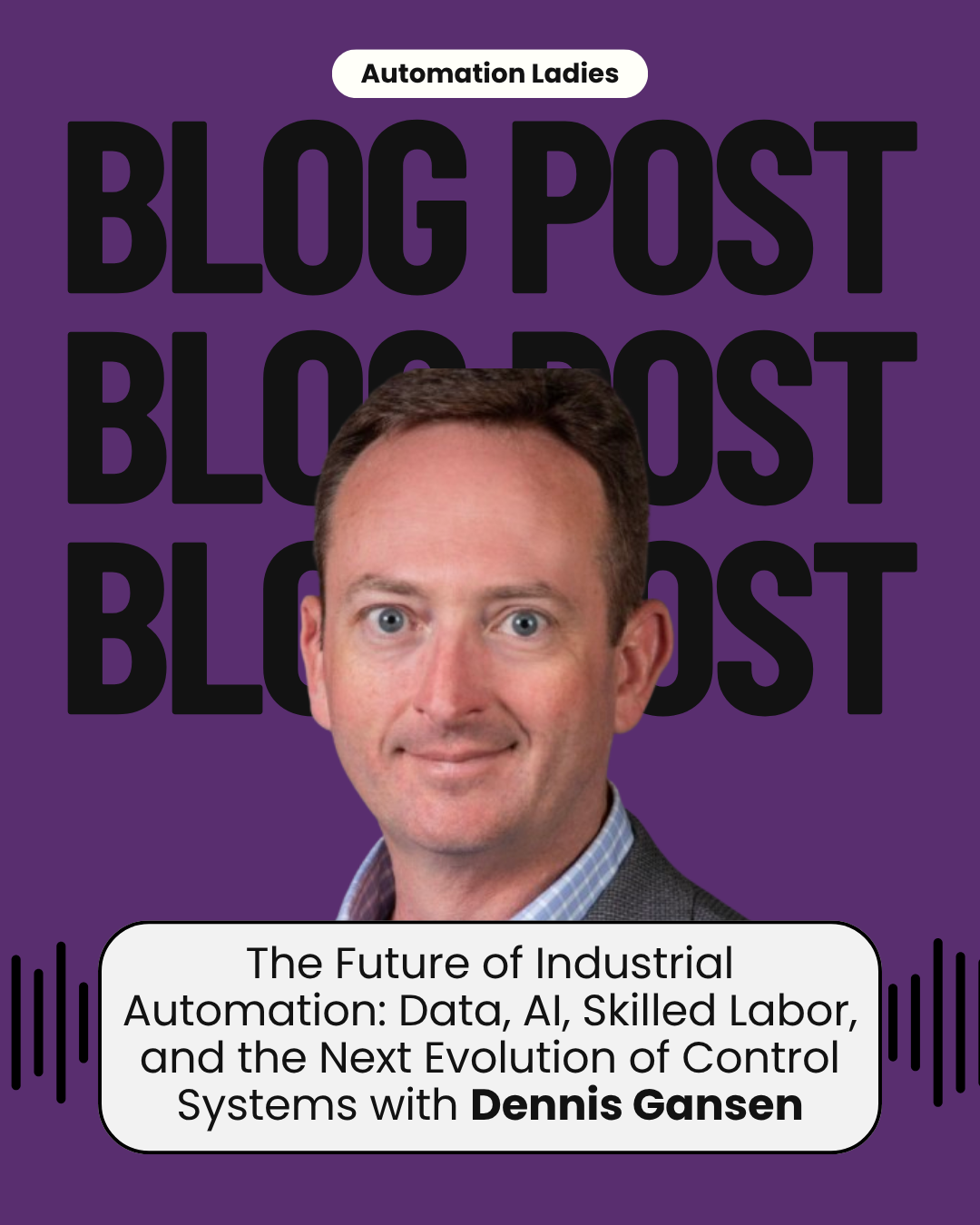
The Future of Industrial Automation: Data, AI, Skilled Labor, and the Next Evolution of Control Systems
Industrial automation is changing quickly.
But what does that actually mean for the people designing, building, selling, and operating these systems?
In this episode of Automation Ladies, Nikki sits down with Dennis Gansen of Schneider Electric for a wide ranging conversation about his path into automation, the growing importance of data, modernizing legacy systems, skilled labor, AI, physical automation, and what the next evolution of industrial control could look like.
It is a conversation that moves from Dennis's career story to some of the biggest questions facing the industry today.
And one thing becomes clear throughout the episode:
The future of automation is not just about better technology. It is also about better information, better collaboration, and people who are willing to look beyond the way things have always been done.
A Nonlinear Path Into Industrial Automation
Dennis's career is a good reminder that there is rarely one standard path into industrial automation.
He graduated from West Point with a degree in mechanical engineering and served five years on active duty in the U.S. Army.
After leaving the military, he joined GE Energy, where he worked in project management and Six Sigma before moving into field service.
That field experience turned out to be important.
Dennis enjoyed being in front of customers and solving problems, and eventually decided to explore sales. He leveraged his technical and power industry experience to move into strategic sales roles before joining Honeywell about 11 years ago.
That was his first major step into automation.
At Honeywell, Dennis worked in strategic sales, managing major accounts and eventually moving into regional sales leadership.
Four months before this episode was recorded, he joined Schneider Electric, where he now leads the U.S. sales organization for process automation.
His career has crossed engineering, power generation, field service, project management, sales, and automation.
And that variety is part of what makes his perspective on the industry so interesting.
Learning Outside Your Specialty
One of the recurring ideas throughout the conversation is the value of understanding more than your immediate area of expertise.
Nikki comes from a more discrete automation background, while Dennis's experience is primarily in process automation.
Dennis explains the difference using a refinery as an example.
Process automation deals with the continuous flow of a process, while a refinery can also contain plenty of PLC based and discrete automation.
That means there is value in understanding both sides.
Dennis is actually planning to use the Automate show to learn more about discrete automation himself. He jokes that he knows the process automation world well, but does not necessarily know what makes a good PLC versus a bad PLC.
That honesty is important.
You do not need to know everything.
But understanding enough about the technologies surrounding your specialty can help you become a better partner to customers and colleagues.
As Nikki points out, sometimes knowing a little outside your area of expertise, combined with knowing who to call when you need deeper knowledge, can make you much more valuable.
Why More Data Can Change Industrial Automation
One of the most technical parts of the conversation focuses on how modern control systems are changing what engineers can do.
Dennis explains that older control system architectures were heavily constrained by the physical cost of wiring and copper.
If bringing another piece of information into the system meant running more wire, there was a practical limit to how much information you would collect.
Modern control systems change that equation.
More data can now be captured from devices and made available to historians, cloud systems, engineering teams, analytics tools, and AI applications.
That creates opportunities for optimization and predictive maintenance.
Instead of replacing a component simply because it has reached a predetermined maintenance interval, organizations can potentially use data to understand when that component is actually approaching failure.
The goal is to avoid both extremes.
You do not want a component to run until it fails.
But you also do not want to replace it unnecessarily when it still has useful life remaining.
Better information can help engineers make that decision more intelligently.
Optimizing the Entire Facility
Dennis also talks about what happens when organizations stop looking at individual systems in isolation.
Historically, advanced process control has often focused primarily on optimizing the process itself.
But if you can combine information from both the power and process sides of a facility, you can begin thinking about optimization at a much broader level.
Instead of asking only how to optimize the process, you can ask how to optimize the entire plant.
That could mean looking at electricity consumption, process conditions, production requirements, and other factors together.
The result is a much broader view of what is happening inside the facility.
And that is one of the major opportunities created by modern control systems.
The data is not valuable simply because there is more of it.
It is valuable because it can be connected, analyzed, and used to make better decisions.
Modernizing Legacy Plants Without Starting Over
Industrial facilities can remain in operation for decades.
That creates an interesting challenge.
How do you bring modern technology into a facility without completely replacing everything that already exists?
Dennis discusses the opportunity to modernize legacy control systems while retaining much of the existing infrastructure.
Instead of removing everything and starting from scratch, newer control technology can fit into existing architectures and connect those older systems to modern controllers and software.
That means a facility can gain access to significantly more information without necessarily taking on the enormous expense of a complete rip and replace project.
For legacy power plants in particular, that can create a major opportunity.
A plant built decades ago may have been designed around very different assumptions about data, computing power, and control systems.
Modernizing the control layer can provide a much clearer picture of what is happening across the operation.
Better Data Can Reduce Over-design
The conversation then moves into something that engineers across many industries can relate to.
Overdesign.
Nikki brings up an example from the world of pneumatics, where components can sometimes be oversized because engineers want to make sure they have enough capacity and because standardization makes that approach easier.
The problem is that those decisions can create cascading inefficiencies.
Larger components can require more energy.
More energy can require larger supporting equipment.
And the result can be a system that is technically capable but more expensive and less efficient than it needs to be.
Dennis connects this idea to engineering more broadly.
With better information, better engineering, better design tools, and increased digitization, engineers can get closer to the real design limits of a system rather than relying so heavily on conservative assumptions.
But there is an important caveat.
Technology does not eliminate the need for engineering judgment.
As Dennis puts it, you cannot take the engineer out.
The tools can help engineers get closer to the limit.
The engineer still needs to understand the information, apply judgment, and decide what makes sense.
The Skilled Labor Bottleneck
The conversation then takes a very human turn.
As power generation and data center construction accelerate, Dennis points out that technology is not the only bottleneck.
There are only so many people available to perform the physical work required to build these projects.
Welding pipe.
Pulling wire.
Performing skilled craft work.
These projects are competing for the same pool of skilled workers.
Nikki connects this to a larger issue that has been developing for years.
Skilled trades have not always been presented as desirable career paths.
For decades, young people were often encouraged to pursue office based or computer focused careers while hands on work was treated as something to avoid.
But that mindset has created a problem.
The industry needs people who can build the physical infrastructure behind all of this technology.
And those jobs are increasingly technology driven themselves.
A Personal Connection to Skilled Trades
Dennis has a personal connection to this topic.
His father was a high school metal shop teacher, and Dennis learned how to weld and work on cars when he was growing up.
He also saw students from his father's classes go on to create their own welding businesses.
His takeaway is straightforward.
Craft labor can provide a great career, and it is essential.
That is an important reminder as conversations about AI and automation often focus on software, robotics, and digital systems.
There is still a physical world that needs to be built.
And people with the skills to build it remain incredibly important.
Will AI Replace Skilled Jobs?
That leads naturally into one of the biggest questions surrounding automation right now.
Will AI eliminate jobs?
Nikki offers her perspective that AI may be more likely to change tasks within jobs rather than eliminate entire occupations.
Dennis agrees, but adds a very simple reality check:
AI cannot weld pipe.
At least, not in the way a human craft worker does today.
But the conversation does not stop there.
Nikki brings up the growing interest in physical AI and humanoid robots, including the humanoid robot pavilion planned for Automate.
She explains how AI is increasingly being combined with physical robots and how training based approaches could potentially lower the barrier to automation.
Instead of explicitly programming every movement, some robots can be trained to perform tasks.
That raises a fascinating possibility.
What happens when physical AI becomes capable enough to perform some of the skilled work we currently assume will always require humans?
Nobody in the conversation claims to know exactly when that will happen.
And that uncertainty is part of the point.
The Next Ten Years Could Look Completely Different
Dennis says he is excited to see what the next ten years bring.
The last decade has already brought enormous changes in AI and automation.
Now there are even more technologies developing simultaneously, and the question becomes how they will eventually consolidate into useful functionality at scale.
Could physical AI eventually weld pipe or pull wires?
Dennis does not pretend to know.
But he does believe that ten years from now, the industry may look very different from what it looks like today.
And that leads to one of the most interesting ideas in the episode.
The person who completely reinvents automation might not be someone who has been working in the industry for 30 years.
They might be in college.
They might even be in high school.
Someone who has not yet been told that something cannot be done may approach the problem completely differently.
That is a powerful reminder for an industry that has good reasons to be cautious.
Industrial systems need to be reliable.
They often need to be proven.
And in safety critical environments, experimentation has limits.
But that does not mean innovation has to stop.
What Does Open Automation Actually Mean?
Near the end of the episode, Nikki asks Dennis about software defined automation, one of the major areas of focus at Schneider Electric.
Dennis describes Foxboro software defined automation as the next evolution of the Foxboro control system.
The goal is to create a more open architecture while maintaining the reliability and design standards expected from industrial control systems.
And Dennis emphasizes one word in particular:
Open.
Software defined automation is not necessarily meaningful if the software is still tied to one specific piece of hardware.
The idea is that software can run in different environments and that third party software can potentially be introduced into the system.
That creates more flexibility.
It also creates an important distinction between being software defined and being genuinely open.
As Dennis puts it, the question is:
Are we really open?
Why Open Architectures Matter
Nikki connects the idea of open architectures to the supply chain problems many industries experienced during COVID.
When a system depends entirely on one specific piece of hardware or one vendor, a supply chain disruption can become a much bigger problem.
If that component is unavailable, the project can be delayed.
And in critical industrial environments, waiting years for a particular piece of hardware is not exactly an acceptable strategy.
Separating software and hardware can create more flexibility.
It can also give customers the ability to select components based on what they actually need rather than being forced into a single vendor ecosystem for every part of the system.
For customers, that could mean greater flexibility in how systems are designed, sourced, and maintained.
Modernization Does Not Mean Abandoning Existing Customers
Dennis also makes an important clarification about Foxboro software defined automation.
The introduction of newer technology does not mean Schneider Electric is abandoning the existing Foxboro installed base.
The company continues to support the systems customers have already invested in while bringing modern technology into the portfolio.
That matters in industrial automation because customers often operate systems for decades.
You cannot simply tell a plant that its existing technology is obsolete and expect it to replace everything overnight.
Modernization has to account for the reality of long equipment lifecycles, reliability requirements, and existing investments.
For Dennis, the newer technology represents the next step in the evolution of the platform, not the abandonment of what came before it.
What Can We Learn From the Future of Automation?
There is no single answer to where industrial automation is headed. And perhaps that is one of the most interesting conclusions from the conversation.
The industry is simultaneously dealing with:
More data. More AI. More demand for automation. Legacy infrastructure. Skilled labor shortages. New approaches to control systems.
Supply chain challenges.
And a generation of engineers and innovators who may approach automation differently from the generations before them.
Technology will continue to evolve.
But the people working with that technology will matter just as much.
Engineers still need judgment.
Skilled tradespeople still need to build the infrastructure.
Customer facing professionals need to understand more than their own specialty.
And companies need to find ways to modernize without leaving existing customers behind.
The future may not look exactly like anyone expects.
That might be the most exciting part.
Listen to the Full Episode
In this episode of Automation Ladies, Nikki and Dennis explore the career paths, technologies, challenges, and ideas shaping the future of industrial automation.
From modern control systems and plant optimization to skilled labor, AI, physical automation, and software defined control, the conversation offers plenty to think about whether you work directly in automation or simply want to understand where the industry is heading.
🎧 Listen to the full episode of Automation Ladies and join the conversation.
What do you think will have the biggest impact on industrial automation over the next ten years?
You Can Learn People Skills Like You Learn PLCs: Alice Rystov and Cassy Gardner on Building a Career in Automation