Bridging the IT/OT Divide: What David Ariens and Willem van Lammeren Want Industry to Understand
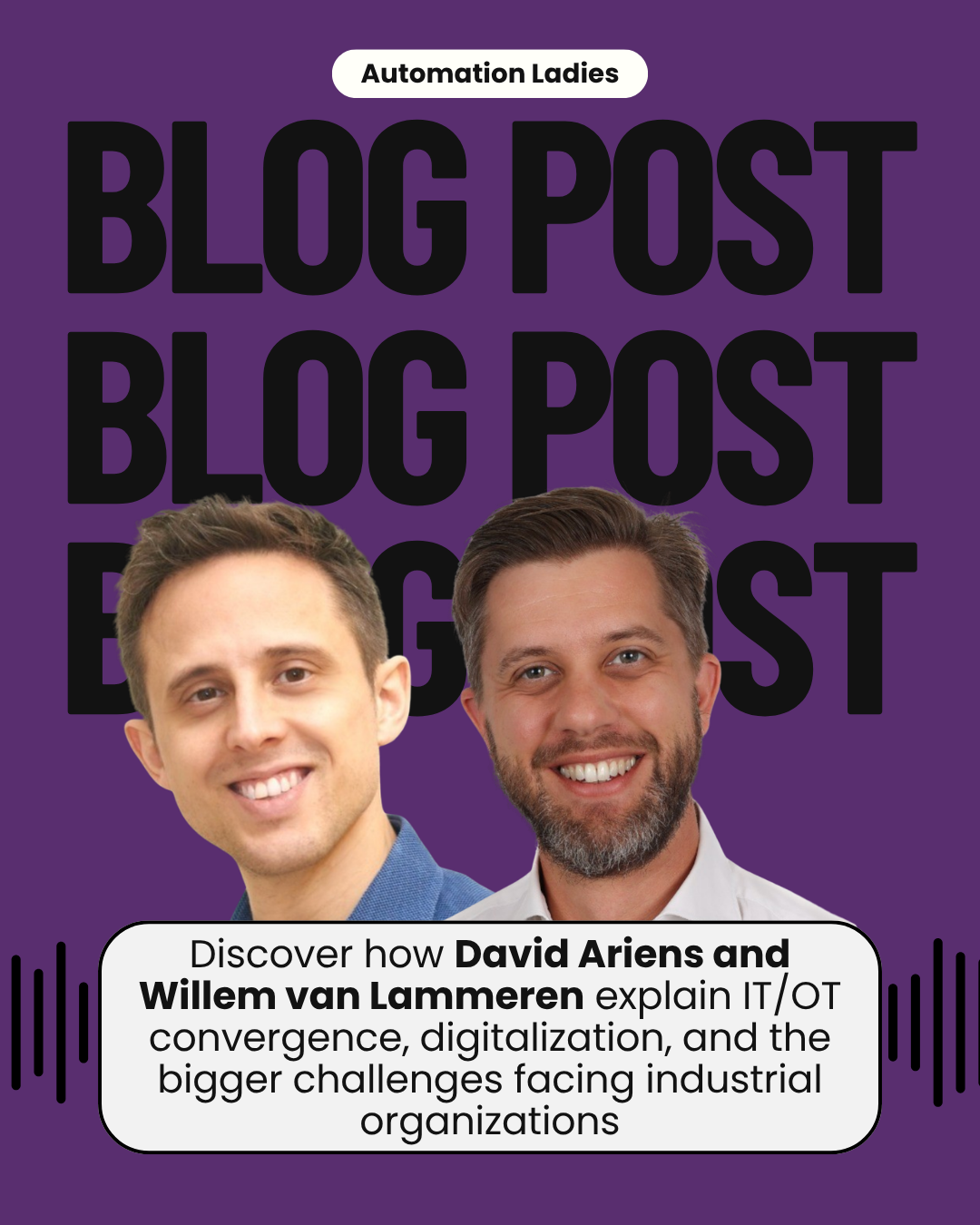
What happens when IT and OT have to work together, but neither side fully understands the other?
That question sits at the center of our latest Automation Ladies episode, a crossover conversation with David Ariens and Willem van Lammeren, the people behind ITOT Insider.
What started as conversations between two former colleagues eventually became a blog, a podcast, an academy, and now the ITOT Handbook, a book focused on the bigger questions surrounding IT/OT convergence and digitalization.
In this episode, David and Willem share how they got into the industry, why ITOT Insider started, what they have learned from working across different industries, and why some of the biggest challenges organizations face today have surprisingly little to do with technology itself.
From Unexpected Career Paths to IT/OT
Neither David nor Willem followed a perfectly straight path into industrial automation.
David describes his career as starting almost entirely by coincidence. With a background in mathematical engineering, his studies focused heavily on data, mathematics, and early AI. He initially had no clear idea that he would end up working in industry.
A university guest lecture changed that.
A conversation with someone from BASF led David into the chemical industry, where he initially worked in data science and mathematical modeling before moving toward systems, automation, and industrial cybersecurity.
Eventually, his career expanded into digitalization and later into the vendor side of the industry, giving him another perspective on how organizations approach technology and problem-solving.
Willem came into the industry through a different route.
After studying chemical engineering and working in several industries, including chocolate, frozen pastry, beer, and chemistry, he entered BASF through IT. His experience working in a plant gave him an important perspective that could help bridge the gap between IT and the production environment.
Eventually, David and Willem found themselves working together on digitalization at BASF's Antwerp site.
Their different backgrounds became part of what made their partnership work.
How IT/OT Insider Started
When David and Willem eventually left BASF around the same time, they realized they missed something that had become a major part of their working relationship: sitting together, thinking through problems, challenging each other's ideas, and trying to figure out complicated issues.
So they started meeting up.
Those conversations eventually became IT/OT Insider.
They noticed that although they were working in different roles and facing different problems, many of the challenges had similar underlying causes.
Instead of keeping those conversations between themselves, they started writing about them.
And that led to one of the most interesting ideas in the episode.
Willem describes ITOT Insider as being born partly out of frustration:
“Why don’t people understand this?”
But the process of writing also forced them to question their own understanding.
Writing something down meant having to explain it. Talking about it meant challenging assumptions. And working through those ideas helped them get past the surface-level symptoms and start looking for the underlying problems.
That approach became a foundation for ITOT Insider.
IT and OT Don't Always See the Same Problem
One of the biggest challenges in IT/OT convergence is that the two sides often approach problems from completely different perspectives.
IT may look at a project and think in terms of months.
OT may be thinking about years.
Neither side is necessarily wrong.
They simply have different priorities, constraints, experiences, and responsibilities.
And when those perspectives collide, organizations can end up with frustration instead of collaboration.
David and Willem argue that the goal isn't to decide whether IT or OT is "right." The goal is to create enough shared understanding that both sides can actually work together.
That becomes increasingly important as companies push further into digitalization, cloud technologies, AI, data, and connected industrial systems.
Because eventually, the people responsible for these technologies have to work with the people responsible for keeping the plant running.
The Biggest Problems Aren't Always Technology Problems
One of the strongest ideas from the episode is surprisingly simple:
The problems organizations face are rarely limited by the technology.
It's easy to focus on technology when talking about digital transformation.
Which platform should we use?
Which architecture makes sense?
Which protocol should we choose?
Which system should we implement?
But David and Willem argue that organizations often run into bigger challenges involving data, data management, communication, relationships between IT and OT, leadership, and organizational silos.
Technology can be part of the solution, but it doesn't automatically solve those problems.
You can have the right technology and still struggle if the people responsible for using it don't agree on what problem they're actually trying to solve.
That's why IT/OT convergence requires more than technical knowledge.
It requires people who can understand different perspectives and help translate between them.
Why Cross-Industry Experience Matters
Another theme throughout the conversation is the value of seeing how other industries solve problems.
David talks about how visiting different plants can completely change the way you think about a problem.
A solution that makes sense in one environment might be impossible in another.
A chemical plant has different requirements than a food and beverage facility. A distillery has different safety considerations than other manufacturing environments. A concrete plant can present completely different environmental challenges.
But the underlying problems can still be surprisingly similar.
That kind of cross-industry exposure can help professionals question assumptions they might otherwise take for granted.
Sometimes the most valuable idea isn't a new technology.
It's realizing that someone in a completely different industry has already approached a similar problem in a different way.
The Growing Need for People Who Can Bridge IT and OT
As organizations become more digital, the need for people who understand both sides becomes increasingly obvious.
The industry doesn't necessarily need everyone to become an IT expert or everyone to become an OT expert.
It needs people who can work between the two.
David and Willem talk about organizations trying to onboard people who don't have traditional OT backgrounds, as well as OT professionals who suddenly need to understand concepts coming from IT.
That creates a valuable opportunity for people willing to develop skills across disciplines.
The same idea applies beyond IT and OT.
As AI becomes more connected to robotics, automation, data, and physical systems, some of the most valuable skill sets may come from combining areas of expertise that traditionally existed separately.
The ability to continuously learn and connect different disciplines can become a major advantage.
So, What Is the ITOT Handbook Actually About?
This is where the conversation gets especially interesting.
David explains that the IT/OT Handbook is more of a business book than a technical one.
That doesn't mean technology isn't important.
It means the book is focused on the bigger questions organizations have to answer when approaching digitalization.
How does an organization decide what actually matters?
How do you build a larger vision?
How do you work across organizational silos?
How do you bring different teams together?
And how do you make decisions without getting trapped in debates over individual technologies?
The book isn't intended to be a simple guide telling readers which technology to choose.
Instead, it's about understanding the bigger picture behind digitalization and IT/OT convergence.
Who Is the ITOT Handbook For?
Interestingly, David says the book isn't really aimed at the pure OT expert or the pure IT expert.
The target audience is the people who have to work between those worlds.
That could include:
-
IT professionals trying to understand OT
-
OT professionals who increasingly need to work with IT
-
Digitalization leaders
-
Team leads and managers
-
Vendors entering the IT/OT space
-
Professionals trying to understand how technology fits into a larger business strategy
It's for people who need to understand not only what technology does, but also how people and organizations actually work with it.
A Free IT/OT Handbook Giveaway
And because this episode is a crossover, we wanted to do something special for our listeners.
David and Willem are giving away 10 copies of the ITOT Handbook to the Automation Ladies community.
Five copies are courtesy of Automation Ladies, and five are courtesy of David and Willem.
To enter:
-
Make a post on LinkedIn and link to the Automation Ladies episode.
-
Tag Automation Ladies and ITOT Insider.
-
Tell us something you liked about the episode, something you didn't like, or a question you had.
-
Make it clear that you listened to the episode and that you'd like a copy of the book.
The first 10 people who do this will receive a free copy.
And if you don't win one, the ITOT Handbook is officially releasing October 6.
The Bigger Lesson
Perhaps the biggest takeaway from this conversation is that IT/OT convergence isn't simply about making two technologies communicate.
It's about making people, teams, and organizations communicate.
Technology will continue to change.
The specific platforms, protocols, tools, and systems we use will evolve.
But the need to understand different perspectives, ask better questions, challenge assumptions, and connect people across disciplines isn't going away.
And that's ultimately what makes the IT/OT Insider conversation so valuable.
It's not just about IT.
It's not just about OT.
It's about what happens in the space between them.
🎧 Listen to the full Automation Ladies x IT/OT Insider episode with David Ariens and Willem van Lammeren to hear the full conversation and learn more about the ITOT Handbook.
What do you think is the biggest challenge standing between IT and OT today: technology, communication, organizational structure, or something else?
You Can Learn People Skills Like You Learn PLCs: Alice Rystov and Cassy Gardner on Building a Career in Automation