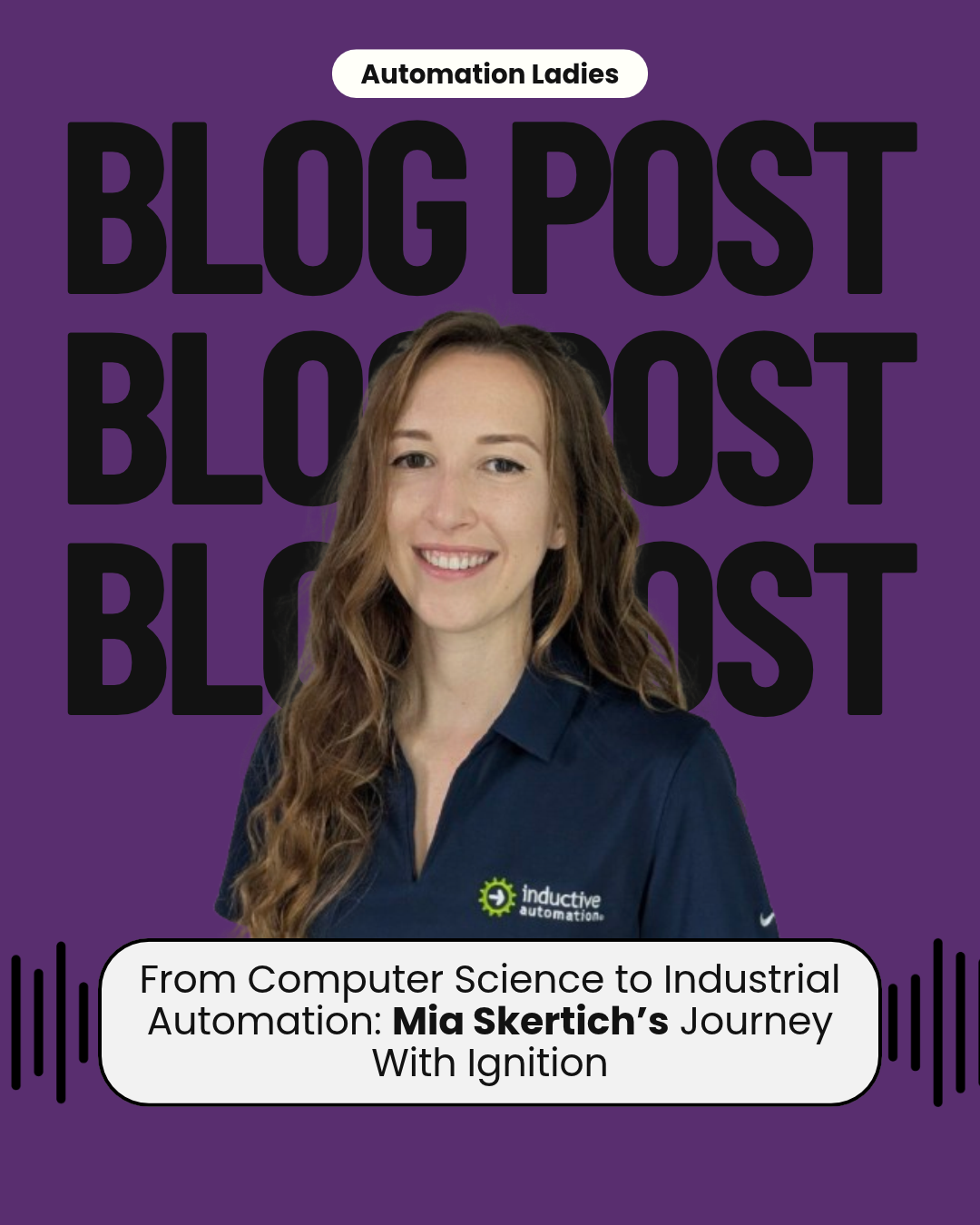
From Computer Science to Industrial Automation: Mia's Journey With Ignition
You don't have to have your entire career figured out to find your place in industrial automation. Sometimes, all it takes is curiosity, a willingness to learn, and the right opportunity.
In our latest episode of Automation Ladies, Ali Gilpin sits down with Mia from Inductive Automation to discuss her journey from studying computer science at Purdue Northwest to developing manufacturing solutions with Ignition and helping others learn the platform.
Her story offers valuable lessons for anyone considering a career in automation, learning a new technology, or looking to grow within the industry.
Discovering Ignition and Finding Her Place in Automation
Mia didn't initially plan to work in industrial automation. She started college studying mechanical engineering but quickly discovered her interest in programming during an introductory engineering course. That experience led her to switch to computer science.
After graduating, she connected with Flexware, where she was introduced to Ignition for the first time. The team recommended Inductive University, Inductive Automation's free online learning platform, and Mia decided to explore it before even knowing whether she would get the job.
She enjoyed being able to follow the training videos while downloading and experimenting with Ignition herself. By her final interview, she had already watched all the available 8.1 credential videos.
That initiative helped her join Flexware's Ignition team, where she spent five years developing manufacturing MES solutions, integrating systems, and facilitating certification training.
Today, she has joined Inductive Automation as an application engineer, creating public demos and resources for the Ignition Exchange.
Learning Ignition: Her Advice for Getting Started
One of Mia's biggest takeaways from learning Ignition is simple: make the manual your best friend.
Instead of guessing how something should work, she recommends taking the time to read the documentation, explore the forums, and experiment.
She also encourages people to take advantage of Inductive University and Ignition certification classes. Even after becoming an experienced developer and helping facilitate training, she continued discovering something new every time she attended a class.
Another important part of her journey has been the Ignition community. Mia describes how willing people are to help one another, even when they have never met.
She also shares how she began posting Ignition tips on LinkedIn, realizing that something that feels obvious to one engineer might be incredibly useful to someone else.
It's a great reminder that sharing what you know is one way to give back to the industry.
AI, Software Development, and What's Next
The conversation also explores AI and its growing role in software development.
Mia currently uses AI as a troubleshooting partner, but she sees potential for it to provide more context to operators working with MES solutions. For example, AI could help identify unfavorable production trends earlier or explain why a part is nonconforming.
However, she also makes an important point about AI-generated code: building something isn't necessarily the hardest part. Troubleshooting it can be.
If you don't understand how your software works, finding and fixing problems can become much more difficult.
Mia also hopes to see more widespread adoption of software engineering practices like Git and version control in industrial automation. She highlights improvements in Ignition 8.3 that support better version control and repeatable deployments, helping development teams avoid lost work and accidental changes.
You Don't Have to Be a Math Genius
For anyone considering computer science or a career in automation, Mia has one final piece of advice: you don't have to be exceptional at math to work in software.
What she enjoys about coding is the same thing she originally liked about math: solving problems systematically, step by step.
Her experience in industrial automation has also shown her just how varied the work can be, from manufacturing applications to completely different customer processes and projects.
The biggest takeaway? You don't need to know everything before getting started. You learn by experimenting, troubleshooting, making mistakes, and continuing to improve.
And sometimes, you might even use Ignition Maker Edition to build an app that reminds you when to water your plants. 🌱
Want to hear more? Listen to the full conversation with Mia and Ali Gilpin on the latest episode of Automation Ladies.
Thank You to Our Sponsor
A special thank-you to Inductive Automation for sponsoring this episode and supporting the Automation Ladies community.
From the Ignition platform to learning resources like Inductive University and the Ignition community, we're grateful for their continued support in helping make industrial automation more accessible.
Explore more at Inductive Automation!

Co-Host & Director of Business Development @Weintek USA
Nikki Gonzales brings 20 years of experience across industrial automation, AI, and technology commercialization. Her career spans sales engineering, startups, commercial leadership, advisory work, and industry media, with roles at Keyence, Festo, CST/Dassault, and early AI supply chain startup Algo, giving her a practical, real-world perspective on emerging technologies.
She is currently Director of Business Development at Weintek USA, working with OEM machine builders in packaging, robotics, and process equipment, and is completing an AI strategy certificate at MIT Sloan and CSAIL.
Nikki co-founded Automation Ladies in 2022 with Alicia Gilpin, growing it from a podcast into a 100+ episode platform with a newsletter, live events, and a global automation community. In 2024, she co-founded OT SCADA CON, a practitioner-focused conference in Houston centered on OT, SCADA, and controls.
A frequent speaker since 2017, she covers AI, IIoT, OT/IT convergence, and career growth, and also serves on the Board of Directors at Process & Controls Energy.
People who know her well call her "Nikkipedia." Friends call her the Director of Silver Linings. Both are accurate.
Building for the Future of Industrial Automation: Lessons from Colby Clegg