Building for the Future of Industrial Automation: Lessons from Colby Clegg
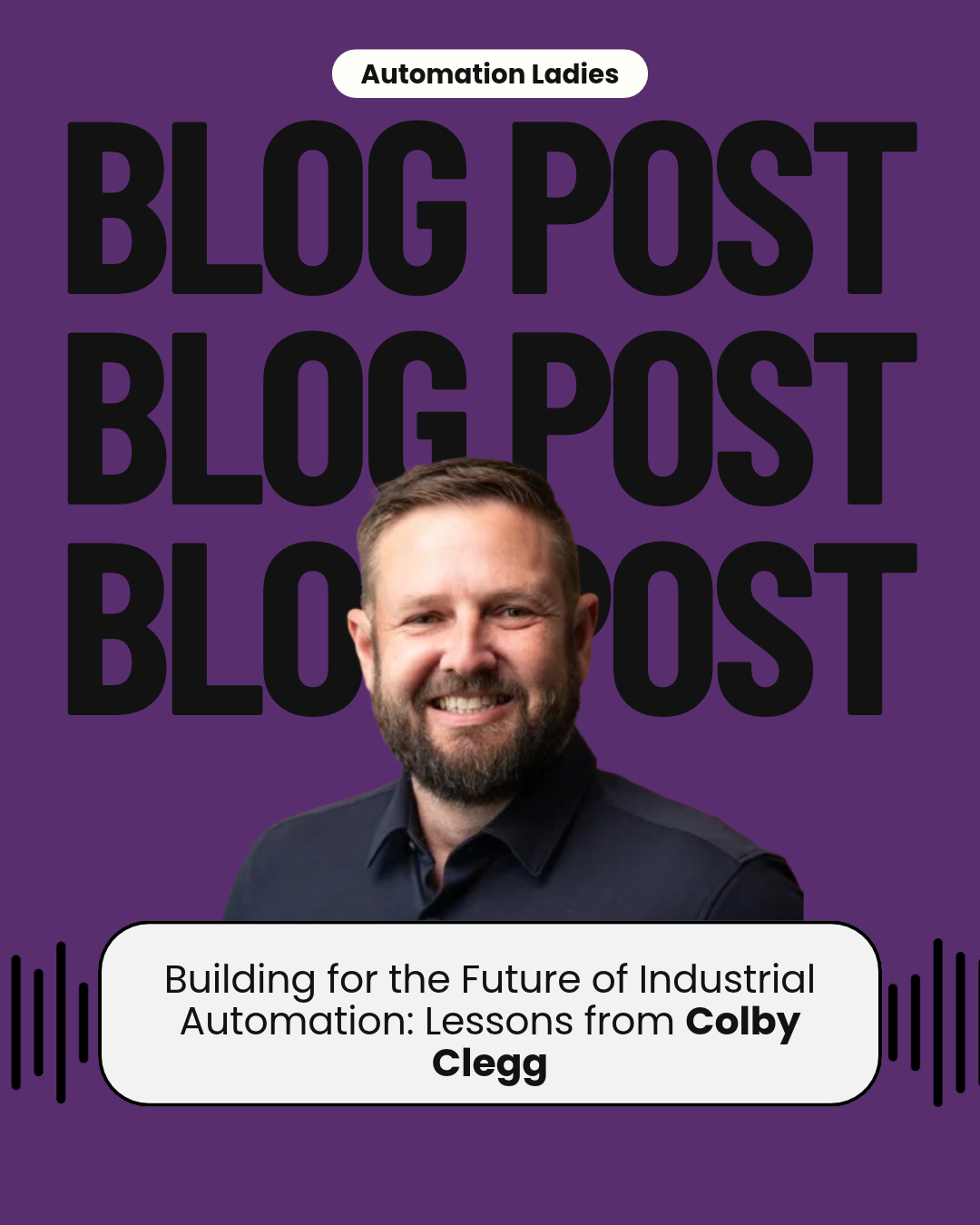
What does it take to build industrial software that lasts? For Colby Clegg, CEO of Inductive Automation, the answer starts with solving real problems, making technology accessible, and staying focused on the people who use it.
Industrial automation is constantly evolving. New technologies are changing how manufacturers operate, how engineers solve problems, and how companies approach modernization. But behind every technological advancement is a more fundamental question: Are we making things better for the people who depend on them?
In the Season 8 premiere of Automation Ladies, Nikki Gonzales sits down with Colby Clegg, CEO of Inductive Automation, to discuss the company's journey, the philosophy behind its software, the importance of accessible education, and what comes next for industrial automation.
His perspective offers valuable lessons for engineers, manufacturing leaders, and anyone interested in building technology that makes a lasting difference.
From Solving a Problem to Building a Platform
Inductive Automation began in 2003, growing out of a systems integration company and the desire to solve practical problems with software.
At the time, the team was frustrated with existing solutions and wanted a better way to connect PLC data to a database. What started as an effort to address a specific technical challenge eventually became something much bigger.
Clegg, who studied software engineering, entered the industrial automation world without an extensive background in the industry. He and his colleague Carl were college contractors when the company's founder, Steve Heckman, brought them on to help develop an idea.
They kept building, kept learning, and kept showing up.
More than two decades later, that original problem-solving mindset remains central to Inductive Automation's approach.
The story is a reminder that innovation doesn't always begin with a grand vision of transforming an entire industry. Sometimes, it starts with recognizing that an existing process could work better and being willing to build a solution.
Why “Easy, Fun, and Affordable” Still Matters
During the conversation, Clegg reflects on a simple philosophy shared by Inductive Automation's founder: software should be easy, fun, and affordable.
These three words communicate more than a product-design preference. They reflect an approach to making technology more approachable and useful.
In industrial automation, complexity can quickly become a barrier. Engineers need tools that help them solve problems without creating unnecessary obstacles. Organizations need solutions that make sense for their operations, and teams need to be able to work with technology rather than spend all their time fighting it.
For Clegg, the idea of making software fun is also connected to what people can accomplish with it. When tools are intuitive and flexible, users can move from an idea to a working solution more quickly.
The larger lesson is that innovation isn't only about adding more capabilities. It's also about making those capabilities easier for people to use.
Making Industrial Automation Education Accessible
One of the most meaningful parts of the conversation is Clegg's explanation of why Inductive University is free.
His reasoning is straightforward:
“We make software, we want people to use it.”
That philosophy reflects the relationship between education and the growth of an industry. When people can access training, develop practical skills, and learn how to use new tools, more opportunities become available to them.
Free training can help someone explore industrial automation for the first time, strengthen their existing technical knowledge, or prepare for a new career. It also helps organizations and the broader industry develop a more knowledgeable community of users.
Access to education matters because not everyone has the same resources or opportunities to learn. Removing the cost of training can make it easier for people to take that first step.
Clegg's perspective is a reminder that supporting an industry's growth doesn't always require creating another product or launching another initiative. Sometimes, it means sharing knowledge and giving people the tools to succeed.
Bringing Software Thinking Into Industrial Automation
Clegg's own background in software engineering also shaped his perspective on the industry.
Inductive Automation has largely hired people with computer science and software backgrounds and taught them about industrial automation. This approach brings different experiences and ways of thinking into a field where reliability, safety, and operational continuity are essential.
However, industrial environments have different constraints from many traditional software settings.
A software application can often be updated or restarted with relatively little disruption. On a production line, downtime can have serious consequences. Industrial systems must account for equipment, processes, and operations that cannot simply be interrupted whenever a change is needed.
That difference helps explain why industrial automation often takes a more cautious approach to change.
The opportunity lies in combining the strengths of both worlds: modern software practices and the practical knowledge required to keep industrial operations running.
As technology evolves, professionals who can understand both the software and the environment in which it operates will continue to play an important role.
AI in Industrial Automation: Innovation Still Requires Judgment
Artificial intelligence was another important topic in the conversation, particularly as Inductive Automation develops tools such as Ignition Catalyst.
The goal is to make it easier for users to create scripts, database queries, and user interfaces with the help of AI-powered capabilities built into the software.
These tools have the potential to help people move faster and make development more accessible. But Clegg also emphasizes an important distinction: an impressive demonstration isn't necessarily the same as a robust, production-ready solution.
AI-generated work still needs to be understood, tested, and evaluated. That is especially important in industrial environments, where a mistake can affect real equipment and operations.
Clegg shares an example from a Build-a-Thon in which teams working with alpha versions of Ignition 2027 and Catalyst completed work in five hours that would typically take three days.
It's an illustration of the potential productivity gains these tools can offer. But the larger point isn't simply that AI can make development faster. It's that new capabilities are most valuable when they are applied responsibly, with appropriate engineering judgment and safeguards.
The future of industrial automation won't be shaped by technology alone. It will also depend on how effectively people understand and apply it.
Modernization Is About More Than Keeping Up
Industrial modernization can be complicated. Many facilities depend on legacy systems that have been operating for years, and replacing equipment or changing infrastructure isn't something that can happen overnight.
Clegg highlights cybersecurity and infrastructure considerations as important reasons to evaluate older systems. A system that continues to perform its intended function may still present challenges as security risks evolve and technology advances.
This makes modernization a planning challenge as much as a technical one.
Organizations need to consider their existing equipment, operational requirements, and the risks associated with delaying upgrades. The objective isn't necessarily to replace everything at once. It's to understand where improvements are needed and develop a realistic path forward.
As AI and other technologies accelerate the discovery of vulnerabilities and change expectations around software, long-term planning becomes even more important.
Modernization should be driven by the needs of the operation, not simply by the desire to adopt the newest technology.
Building a Community Around Technology
Another recurring theme in Clegg's conversation is the importance of community.
Inductive Automation's Ignition Community Conference, along with initiatives such as Discovery Days and Inductive University, creates opportunities for users to learn, exchange ideas, and connect with others working in industrial automation.
Clegg values the company's approachability and the relationships that develop through these interactions. He also emphasizes the importance of customer feedback throughout the organization, including among developers.
That connection helps ensure the company is addressing actual problems rather than designing solutions around assumptions alone.
For an industry built around complex systems and specialized knowledge, these opportunities to learn from others can be especially valuable. A strong community helps people share what works, learn from different experiences, and discover new ways to approach familiar challenges.
Technology may be the product, but people remain central to how it evolves and how successfully it is used.
The Value of Thinking Long-Term
Clegg also discusses the principles that guide Inductive Automation, including responsibility, empowerment, and long-term vision.
The company has maintained its independence, which he describes as an important factor in its ability to focus on its direction over time.
A long-term perspective can influence how a company invests in its products, supports its customers, and makes decisions about growth. It creates room to consider what users will need in the future rather than focusing exclusively on immediate results.
For industrial automation, where systems and infrastructure often remain in place for years, that perspective is particularly relevant.
The choices companies make today can influence how easily customers maintain, expand, and modernize their systems in the years ahead.
Building for the future means considering not only what technology can do now, but also how it will serve the people and operations that depend on it over time.
Looking Ahead
Colby Clegg's conversation with Automation Ladies offers a perspective on industrial automation that goes beyond individual products or technological trends.
It highlights the value of solving real problems, designing approachable software, making education accessible, and investing in relationships with the people who use the technology.
It also reinforces an important principle for an industry experiencing rapid change: progress requires both innovation and judgment.
AI can accelerate development. Modern software practices can help organizations evolve. Education can open doors for new talent. And community can help people learn from one another.
But these opportunities are most meaningful when they address real needs and support the people responsible for making industrial systems work.
As industrial automation continues to evolve, the challenge isn't simply to build more advanced technology. It's to build technology that people can understand, use, and rely on.
Listen to the Season 8 premiere of Automation Ladies featuring Colby Clegg, CEO of Inductive Automation, for the full conversation about the company's journey, its philosophy, and the future of industrial automation.
What do you think matters most when building technology for the long term: accessibility, reliability, education, or innovation?
Thank You to Our Sponsor: Inductive Automation
A special thank you to Inductive Automation, our sponsor this month, for supporting Automation Ladies and helping us continue to share meaningful conversations with the people shaping industrial automation.
From developing innovative software solutions to making technical education more accessible through Inductive University, Inductive Automation is helping people learn, build, and move the industry forward.
We're grateful for their support and for the opportunity to bring conversations like this one with Colby Clegg to our community.
Thank you, Inductive Automation, for being part of the Automation Ladies journey! 💜
Bridging the IT/OT Divide: What David Ariens and Willem van Lammeren Want Industry to Understand