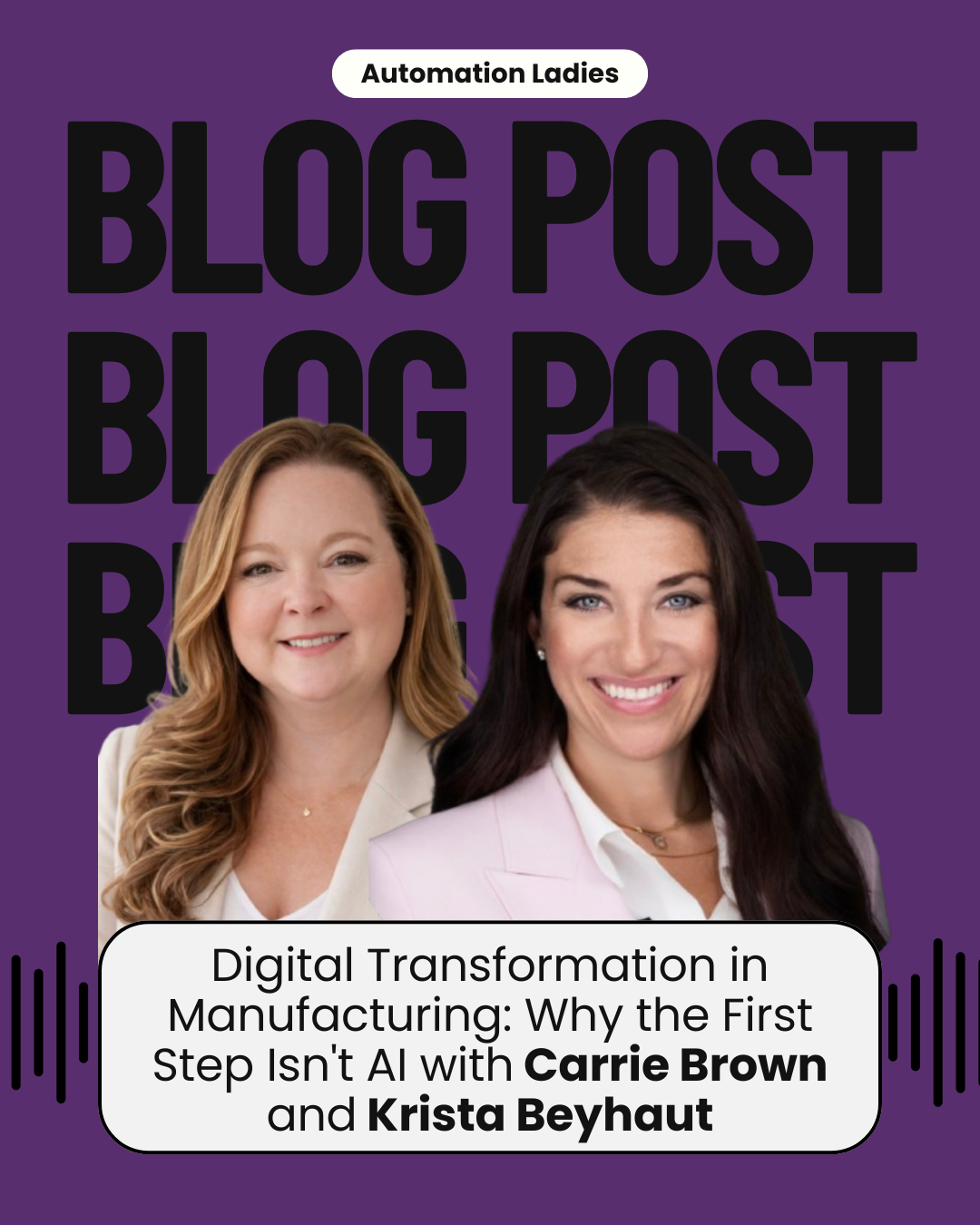
Digital Transformation in Manufacturing: Why the First Step Isn't AI with Carrie Brown and Krista Beyhaut
Manufacturers are hearing the same message from every direction: modernize, digitize, automate, and adopt AI.
But for many operations leaders, plant managers, and engineers, the reality on the plant floor looks very different.
Some facilities are implementing advanced analytics, AI-driven predictive maintenance, and autonomous mobile robots. Others are still running reliable equipment that's been in service for decades.
In a recent episode of Automation Ladies, Carrie Brown and Krista Beyhaut from Wesco joined host Nikki Gonzales to discuss what digital transformation actually looks like inside manufacturing organizations today, and why successful modernization starts long before AI enters the conversation.
Every Manufacturer Is on a Different Journey
One of the biggest misconceptions about digital transformation is that there's a universal roadmap.
The reality is that every facility starts from a different place.
Some manufacturers are investing heavily in greenfield facilities designed around modern automation architectures. Others are operating brownfield sites where equipment has been running successfully for 20 or 30 years.
For many organizations, modernization isn't about deploying cutting-edge technology. It's about solving practical problems:
-
Replacing obsolete equipment
-
Improving visibility into operations
-
Connecting previously isolated systems
-
Reducing downtime
-
Addressing workforce challenges
-
Creating a foundation for future technology investments
As Carrie explained during the conversation, the key is meeting manufacturers where they are rather than pushing a one-size-fits-all solution.
Why AI Isn't Always the First Step
Artificial intelligence continues to dominate conversations throughout manufacturing.
Plant leaders are increasingly interested in predictive analytics, AI copilots, machine learning, and automated decision-making tools.
But AI is only as valuable as the data that supports it.
Many manufacturers still face fundamental challenges:
-
Legacy equipment that isn't connected
-
Inconsistent data collection
-
Limited visibility across operations
-
Siloed systems that don't communicate
-
Missing documentation and outdated infrastructure
Without addressing these foundational issues, AI initiatives often struggle to deliver meaningful results.
That's why both Carrie and Krista emphasized the importance of assessment before implementation.
Before investing in advanced technologies, manufacturers need a clear understanding of their current state, operational risks, and opportunities for improvement.
The Power of a Manufacturing Assessment
One of the most practical insights from the episode was the role that assessments play in modernization efforts.
Rather than starting with a technology solution, Wesco begins by helping customers understand where they currently stand.
These assessments evaluate factors such as:
-
Connectivity across the plant floor
-
Existing automation infrastructure
-
Cybersecurity readiness
-
Data accessibility
-
Integration between operational and business systems
-
Obsolescence risks
-
Workforce capabilities
The goal is not simply to identify problems.
It's to build a realistic roadmap that aligns technology investments with business objectives.
For some manufacturers, the next step may be implementing advanced analytics. For others, it may be something as fundamental as updating documentation or replacing unsupported hardware.
A Real-World Example of AI Delivering Results
While AI may not be the first step for every facility, the conversation highlighted a powerful example of where it can create significant value.
A large engine manufacturer had years of production and performance data available but wasn't fully leveraging it.
Working with an AI-focused integration partner, historical production data was combined with real-world field failure information to train predictive models.
The result was an AI system capable of identifying potential failures before products reached customers.
According to Carrie, the model achieved approximately 80% accuracy and helped prevent multiple costly field failures.
The lesson wasn't simply that AI works.
The lesson was that AI works best when organizations already have the right data foundation in place.
Technology Alone Doesn't Drive Transformation
One topic that often gets overlooked during modernization discussions is change management.
Even the most advanced technology can struggle if the workforce isn't aligned with the initiative.
Krista emphasized the importance of helping employees understand the "why" behind new technologies.
Successful transformations require:
-
Early employee involvement
-
Clear communication
-
Workforce education
-
Leadership alignment
-
Practical training
Technology adoption is ultimately a people challenge as much as it is a technical challenge.
Organizations that invest in both tend to achieve stronger long-term results.
What Comes Next for Manufacturing?
Looking ahead, both guests pointed to several technologies worth watching.
Autonomous Mobile Robots (AMRs) continue gaining traction as manufacturers look for ways to address labor shortages and improve material movement.
AI copilots are beginning to appear inside engineering and operational software platforms, helping users troubleshoot issues, generate code, and accelerate problem-solving.
Perhaps most interestingly, the industry is beginning to explore a future where AI moves beyond assisting workers and starts participating directly in operational decision-making.
While that future may still be developing, one thing is clear:
The manufacturers that will benefit most from these technologies are the ones building strong foundations today.
Modernization Is a Journey, Not a Destination
Digital transformation isn't a checklist.
It's an ongoing process of improving visibility, reducing inefficiencies, empowering employees, and creating systems that can adapt to future challenges.
For some manufacturers, that journey may begin with AI.
For many others, it starts with a simple question:
"Where are we today?"
The answer to that question often determines everything that comes next.
Bridging the IT/OT Divide: What David Ariens and Willem van Lammeren Want Industry to Understand