Why Career Paths Are Not Linear Lessons from Engineering, Writing and Real World Experience with Rachael Pasini
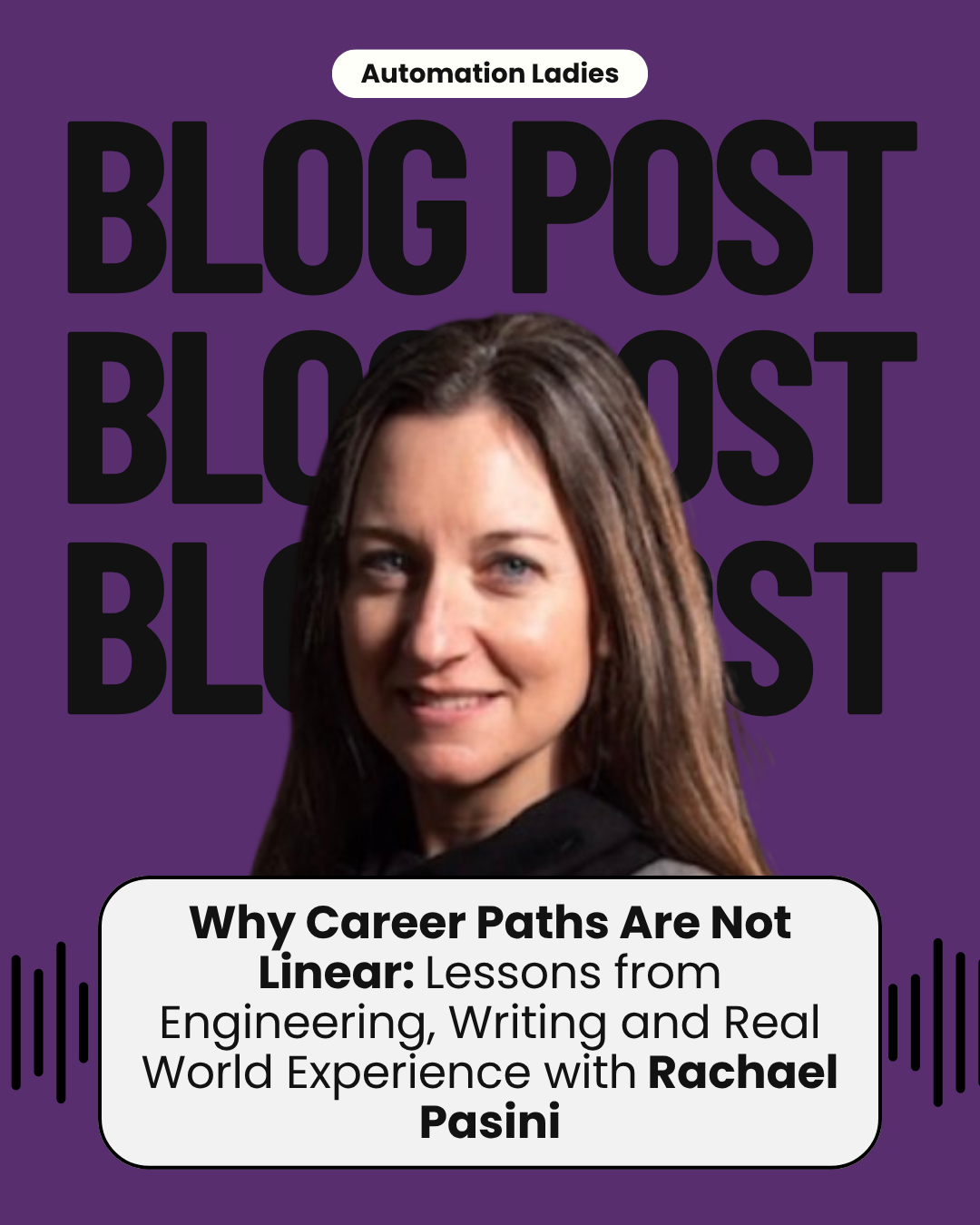
In this episode of the Automation Ladies podcast, Nikki Gonzales sits down with Rachael Pasini, Editor in Chief of Design World, to explore a topic that resonates across manufacturing, engineering, and modern careers: why career paths are rarely linear and why that is not a problem.
Rachael’s journey from studying engineering to leading in technical media is not a straight line. It is a path shaped by curiosity, experimentation, and a willingness to evolve. Her story reflects a broader truth in industrial automation and manufacturing careers. The most impactful professionals are often the ones who explore beyond rigid definitions of success.
This conversation moves beyond technical roles and into the human side of work, including identity, leadership, self doubt, and how to build a meaningful career in a constantly changing industry.
From Engineering to Writing in Industrial Media
Rachael Pasini began her career with a clear direction. She pursued both a bachelor’s and master’s degree in engineering, driven by a desire to solve meaningful problems and make an impact. Like many engineers, she followed a structured path with discipline and focus.
But over time, something shifted.
Writing, a passion she had since childhood, began to pull her in a different direction. After experiencing burnout from a highly structured and goal oriented path, she chose to explore a more creative route. That decision led her into technical writing and eventually into B2B journalism within the manufacturing and automation space.
Today, she combines both worlds. Her engineering background gives her technical credibility, while her writing allows her to tell the stories of the people building the systems that power modern industry.
Her journey highlights an important lesson. The skills you develop are often more valuable than the exact role you start in.
There Is No Single Right Career Path
One of the most powerful takeaways from this episode is the idea that there is no “correct” path.
With an engineering mindset, many professionals look for the right answer. The right job. The right decision. The right trajectory.
Rachael challenges that thinking.
She explains that careers are shaped by exploration, not certainty. Many people who follow rigid, highly defined paths eventually pivot or leave those fields altogether. Others who start without a clear direction often discover their strengths through experience.
The key is not having everything figured out. The key is continuing to move forward.
As long as you are learning, you are progressing.
Why Patience and Experimentation Matter Early in Your Career
If Rachael could give advice to her younger self, it would be simple: be patient and keep going.
Early career professionals often feel pressure to “arrive” quickly. To reach a milestone that proves they are successful. But that feeling of arrival rarely comes in the way people expect.
Instead, careers unfold over time.
Experimentation plays a critical role in that process. Trying roles you are unsure about, exploring different industries, and stepping outside your comfort zone all help you understand where you bring value.
Equally important is recognizing what is not a fit. Knowing where not to invest your time is just as valuable as knowing where to focus.
How Skills Transfer Across Roles in Manufacturing and Engineering
A major theme in this conversation is the idea that skills are transferable across roles.
Engineering does not only lead to traditional engineering jobs. It can lead to careers in writing, marketing, sales, leadership, and media. The same is true for many disciplines in manufacturing and automation.
Rachael’s career is a perfect example of this.
Her technical background allows her to understand complex systems. Her communication skills allow her to translate that complexity into insights that others can learn from.
This combination is increasingly valuable in an industry that depends on both technical expertise and clear communication.
The Role of Personal Development in Technical Careers
This episode also explores something that is often overlooked in engineering and manufacturing conversations: personal development.
Rachael emphasizes that success is not only about technical ability. It is also about self awareness, emotional intelligence, and the ability to manage yourself.
In high pressure environments, professionals bring more than just their skills to work. They bring stress, responsibilities, and personal challenges. Recognizing that reality and approaching others with empathy can significantly improve collaboration and leadership.
She also highlights the importance of managing emotions rather than ignoring them. Feelings influence decisions, relationships, and performance. Learning how to navigate them is a critical part of long term success.
Leadership in Manufacturing Is About Service and Execution
As a leader, Rachael does not view leadership as control or authority.
Instead, she sees it as service.
Great leadership in manufacturing and industrial automation is about bringing people together, aligning ideas, and driving execution. It is about creating an environment where different perspectives and skill sets can work toward a shared goal.
This approach reflects the reality of modern industry. Complex systems require collaboration across disciplines, and strong leaders facilitate that collaboration rather than dictate it.
Why Happiness Is Not Tied to Career Milestones
Another key insight from this episode is the relationship between work and happiness.
Many professionals believe they will feel fulfilled once they reach a certain role, salary, or level of success. But as both Nikki and Rachael discuss, that sense of fulfillment is not tied to external achievements.
Happiness is driven by mindset.
Approaching work with curiosity, gratitude, and a focus on contributing to others creates a more sustainable sense of fulfillment. This perspective is especially important in industries like manufacturing, where challenges and uncertainty are constant.
Finding Your Place in Industrial Automation
For those early in their careers or feeling uncertain about their path, this episode offers a clear message.
Keep going.
Industrial automation and manufacturing offer a wide range of opportunities. From engineering and controls to writing, marketing, and leadership, there are countless ways to contribute.
The more you explore, the more likely you are to find the intersection of your skills, interests, and impact.
Rachael Pasini’s journey shows that you do not need a perfect plan. You need curiosity, persistence, and the willingness to evolve.
Listen to the Full Episode with Rachael Pasini
This conversation is a reminder that careers are not defined by a straight line, but by the experiences and lessons gathered along the way.
If you are navigating your own path in manufacturing, engineering, or industrial automation, this episode offers both perspective and reassurance.
Listen to the full Automation Ladies episode with Rachael Pasini to hear more insights on career growth, leadership, and finding meaning in your work.
You Can Learn People Skills Like You Learn PLCs: Alice Rystov and Cassy Gardner on Building a Career in Automation