Why Robotics Education Needs To Start Earlier: Lessons from Dr. Elliot Heflin Jr.
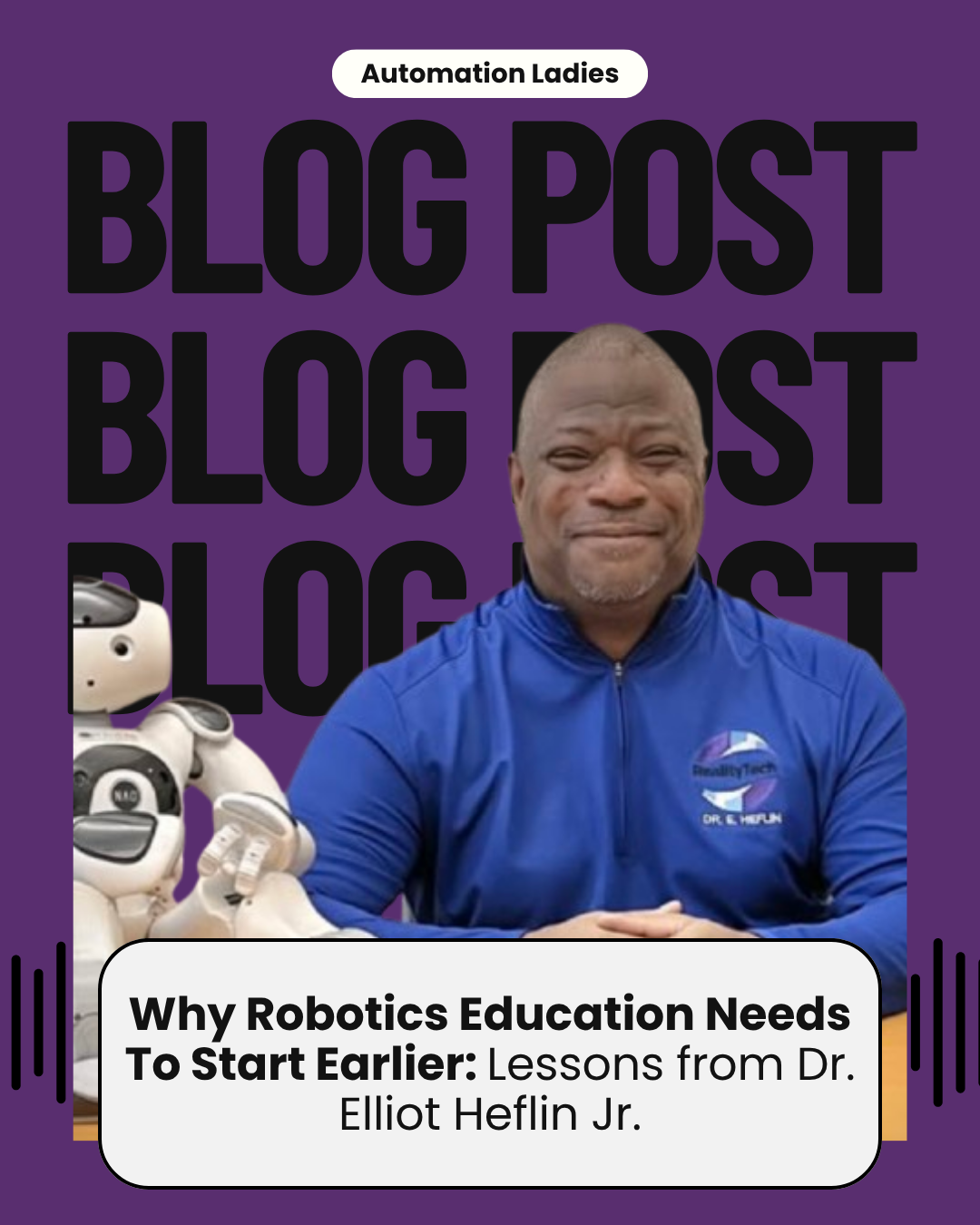
Humanoid robots often get attention because they look futuristic.
But one of the most practical questions behind them is much simpler:
Who will know how to build, program, maintain, and troubleshoot them when they become part of everyday life?
That question shaped a recent Automation Ladies conversation with Dr. Elliot Heflin Jr., founder of Reality Tech Academy, who has spent years bringing full-scale humanoid robotics directly into learning environments for students who often have limited access to advanced STEM opportunities.
Teaching the Real Thing Earlier
One of Dr. Heflin’s strongest points was that many students are introduced to robotics through simplified kits, drag-and-drop tools, or highly controlled exercises.
Useful entry points, but not enough to show what robotics actually becomes in real technical work.
His approach is different:
Students work with humanoid robots such as Pepper and NAO while learning the systems behind movement, interaction, and programming. That includes Python, simulation tools, and understanding why machines behave the way they do.
The goal is not only excitement.
It is familiarity with the real logic behind the machine.
Producers, Not Just Users
A theme that surfaced repeatedly in the episode was one Dr. Heflin returns to often:
Students should become producers, not just users.
That means understanding what happens behind interfaces, behind movement, behind responses.
Not every student will become a robotics engineer.
But more students will eventually live and work around intelligent systems, and the people who understand how those systems function will always have a different level of opportunity.
Why Middle School Matters So Much
One particularly interesting insight from the conversation was age.
Dr. Heflin explained that middle-school students are often the most receptive to robotics because they approach it with fewer assumptions.
They imagine uses adults have not considered yet.
They ask questions without hesitation.
And often, one early interaction with advanced technology becomes the moment that changes how they imagine their future.
Research across robotics education continues to support this idea: early interaction with real robotic systems improves confidence and interest in technical pathways, especially among underrepresented students.
Why This Matters Beyond Education
Humanoid robotics is no longer only a research topic.
Companies including Boston Dynamics are already pushing humanoid robots into practical industrial environments, where maintenance, programming, and adaptation will require new skill pipelines.
That makes workforce development part of the robotics conversation now, not later.
The future challenge is not only whether robots will expand.
It is whether enough people will understand them well enough to guide that expansion responsibly.
The Bigger Lesson
Exposure changes confidence.
Confidence changes direction.
And sometimes what changes a student’s future is simply seeing technology close enough to imagine belonging in the field that creates it.

When the Automation Community Shows Up: A Conversation That Says a Lot About This Industry