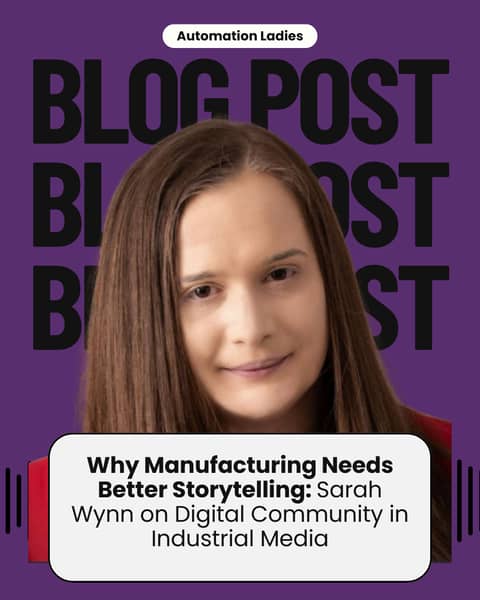
Why Manufacturing Needs Better Storytelling: Sarah Wynn on Digital Community in Industrial Media
In industrial automation, strong technical work often speaks for itself on the plant floor.
But outside the plant, someone still has to tell the story.
That is where voices like Sarah Wynn are helping reshape how the manufacturing world connects.
As Senior Editor (Digital) for WTWH Media’s Packaging OEM, Sarah sits at the intersection of journalism, digital media, packaging, and industrial technology. She also co-hosts The Downtime, a weekly manufacturing podcast focused on trends, technology, and conversations across the industry.
What makes her perspective especially relevant is that she did not come from traditional print publishing. Her background is digital first.
And that matters more than ever.
Digital storytelling is changing how manufacturing gets seen
Manufacturing has no shortage of innovation.
What it often lacks is visibility.
Sarah explained that her professional background has always centered on digital platforms: content built for speed, accessibility, and engagement rather than traditional print cycles.
That mindset translates naturally into today’s industrial world, where engineers, OEMs, integrators, and manufacturers increasingly discover each other through videos, social media, trade show coverage, and podcasts.
Industrial media is no longer just reporting what happened.
It is helping shape what people pay attention to.
Trade shows are now year-round content engines
One of the strongest themes from the conversation was how trade shows have evolved.
For years, events were mainly about what happened on-site.
Today, shows like PACK EXPO often generate months of digital conversation before and after the event itself.
A single booth visit can become:
a LinkedIn video
a short interview clip
a podcast conversation
a written feature
a long-term industry connection
That shift has changed how industrial brands communicate.
For many companies, digital content now extends the life of every event far beyond the convention floor.
Why relationships still drive industrial media
Despite the digital tools, one thing has not changed: manufacturing remains deeply relationship-driven.
Sarah described how much of industrial media still depends on trust, consistency, and real conversations with people who know the work.
That is especially true in automation, where technical credibility matters.
The strongest content often comes from understanding not only the equipment, but also the people behind it.
That is why industrial journalism works best when it stays close to practitioners.
Podcasts are becoming part of industrial influence
Through The Downtime, Sarah helps bring manufacturing conversations into a more conversational format.
Podcasts are increasingly important because they allow technical professionals to explain ideas in ways articles sometimes cannot.
A machine spec can be read in seconds.
A story about why that machine matters takes longer, and often creates stronger connection.
That is part of why podcasting continues to grow across industrial media.
The future belongs to technical people who can communicate
One clear takeaway from the episode:
Technical industries need more people who can explain complex work clearly.
Not just engineers. Not just editors. But professionals who understand both.
As industrial automation continues evolving, communication itself becomes a competitive skill.
Because the companies that explain their value best often build stronger communities around what they do.
Why this matters for industrial automation right now
Automation, packaging, controls, and manufacturing are moving fast.
The companies gaining attention are often the ones showing their work consistently:
on video
through podcasts
through field reporting
through social platforms
That visibility creates opportunity.
And as Sarah’s career shows, there is growing space in manufacturing for people whose skill set begins with storytelling.
Why Community Events Matter in Industrial Automation