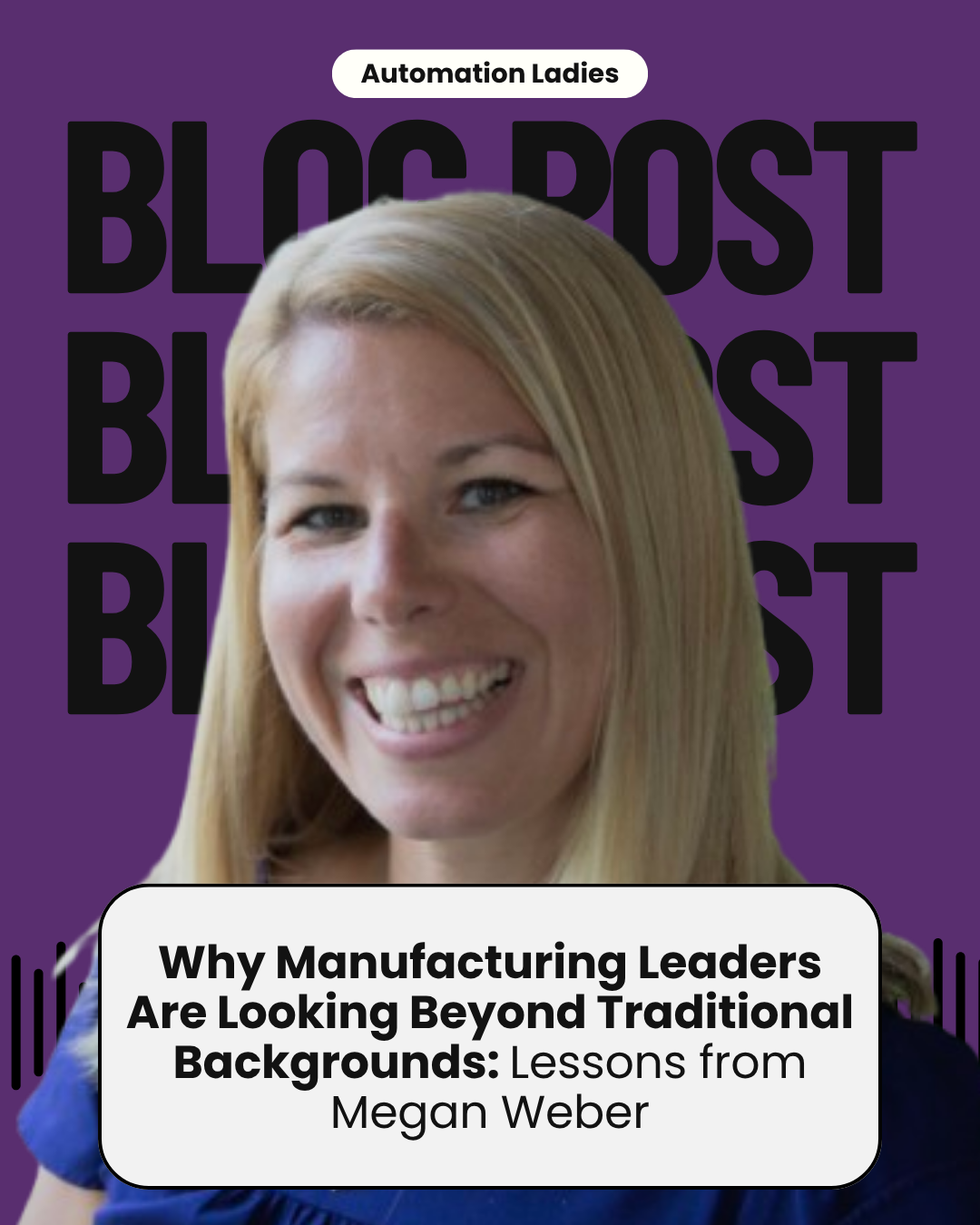
Why Manufacturing Leaders Are Looking Beyond Traditional Backgrounds: Lessons from Megan Weber
What Manufacturing Leaders Can Learn from Unconventional Career Paths
Not every manufacturing leader starts on the plant floor.
Some begin in industries that seem completely unrelated, then discover that the skills they built elsewhere translate more directly than anyone expects.
That is exactly what makes the conversation with Megan Weber so relevant right now.
In the latest Automation Ladies episode, Megan, Director of Manufacturing at Sentry Equipment, explains how a career that began in hospitality eventually led her into manufacturing leadership, continuous improvement, and operational decision-making inside a technical industrial environment. Her story highlights something many manufacturers are actively confronting today: the strongest leaders do not always come from traditional engineering paths.
Why Hospitality Skills Translate Surprisingly Well to Manufacturing
Hospitality teaches fast decision-making, communication under pressure, and the ability to manage unpredictable situations without losing focus.
Those same skills matter every day in manufacturing.
When Megan entered the industry, she did not arrive with a production background or engineering degree. What she brought instead was an ability to manage people, solve problems quickly, and adapt in real time.
That foundation became valuable because manufacturing leadership often depends just as much on communication and judgment as it does on technical knowledge.
As labor shortages continue across manufacturing, more companies are recognizing that capability is often easier to develop than mindset. Hiring managers increasingly look for people who can learn quickly, take ownership, and contribute to team culture from day one.
Why Sentry Equipment Starts with Culture Before Skills
One of the strongest ideas from the episode is Sentry’s hiring approach.
Before technical qualifications are evaluated, candidates first go through a culture interview.
The purpose is simple: determine whether someone will thrive in the company’s environment before focusing on specific job skills.
That philosophy reflects a larger workforce trend across industrial companies. Technical training can be built internally. Curiosity, coachability, and openness to feedback are much harder to install later.
For manufacturers trying to improve retention, this approach matters because poor technical gaps can often be closed, while poor team fit usually becomes expensive over time.
Continuous Improvement Still Depends on People
Megan also describes how learning systems like Lean, QRM, and Six Sigma expanded her role over time.
These tools matter, but the larger takeaway is that continuous improvement only works when people understand why changes are happening.
Manufacturing systems improve fastest when teams trust leadership enough to participate in change instead of resisting it.
That means leadership today requires more than process knowledge. It requires the ability to communicate clearly across departments, align different personalities, and help teams see where they fit inside larger operational goals.
The Hidden Manufacturing Risk: Tribal Knowledge
Another major topic in the conversation is something nearly every manufacturer faces: knowledge that lives only inside experienced employees.
When process knowledge stays informal, companies become vulnerable every time someone leaves, retires, or changes roles.
At Sentry, that has created a push toward clearer documentation, stronger work instructions, and easier process access.
For industrial companies scaling operations, this is no longer optional. Process clarity directly affects training speed, consistency, and long-term resilience.
AI in Manufacturing Still Requires Human Judgment
The episode also touches on AI in a way that feels especially practical.
Megan’s perspective is not anti-AI. It is realistic.
Tools like AI can accelerate drafts, organize ideas, and save time. But in manufacturing, where precision matters, outputs still need human review.
A polished answer is not the same as a correct one.
That distinction matters because technical environments cannot afford confident mistakes.
The strongest use of AI inside industrial work is not replacing expertise, but helping skilled people move faster while remaining accountable for final decisions.
What This Means for Manufacturing Leadership Right Now
The bigger lesson from Megan’s story is that modern manufacturing leadership is increasingly interdisciplinary.
The strongest teams are often built by combining technical depth with communication, adaptability, and learning speed.
That applies to hiring, promotion, training, and long-term retention.
As more manufacturers compete for talent, unconventional backgrounds may become one of the industry’s strongest advantages rather than an exception.
🎙️ For the full conversation, listen to the latest Automation Ladies episode with Megan Weber and hear how culture-first hiring, continuous improvement, and nontraditional leadership paths are shaping manufacturing today.